
The Independent Football Regulator is here. Here’s what you need to know. By Stefan Borson
English football has a new regulator with real powers and a proactive mandate. It is ready to use them.
The Football Governance Act 2025 received Royal Assent in July 2025, creating the Independent Football Regulator (IFR), the first statutory body to oversee the men’s professional game in England. The trigger was years of governance failures, the inability of the Premier League and the EFL to agree a financial subsidy, the near-miss of a breakaway European Super League, and a growing consensus that self-regulation had run its course. The IFR covers all 116 clubs across the top five divisions, from the Premier League to the National League, and no club sits outside its reach.
What the IFR does
Three objectives sit at the heart of the Act: protecting and promoting the financial soundness of individual clubs, protecting and promoting the financial resilience of the pyramid as a whole, and safeguarding the heritage of English football. Everything the IFR does is anchored to one or more of those three things.
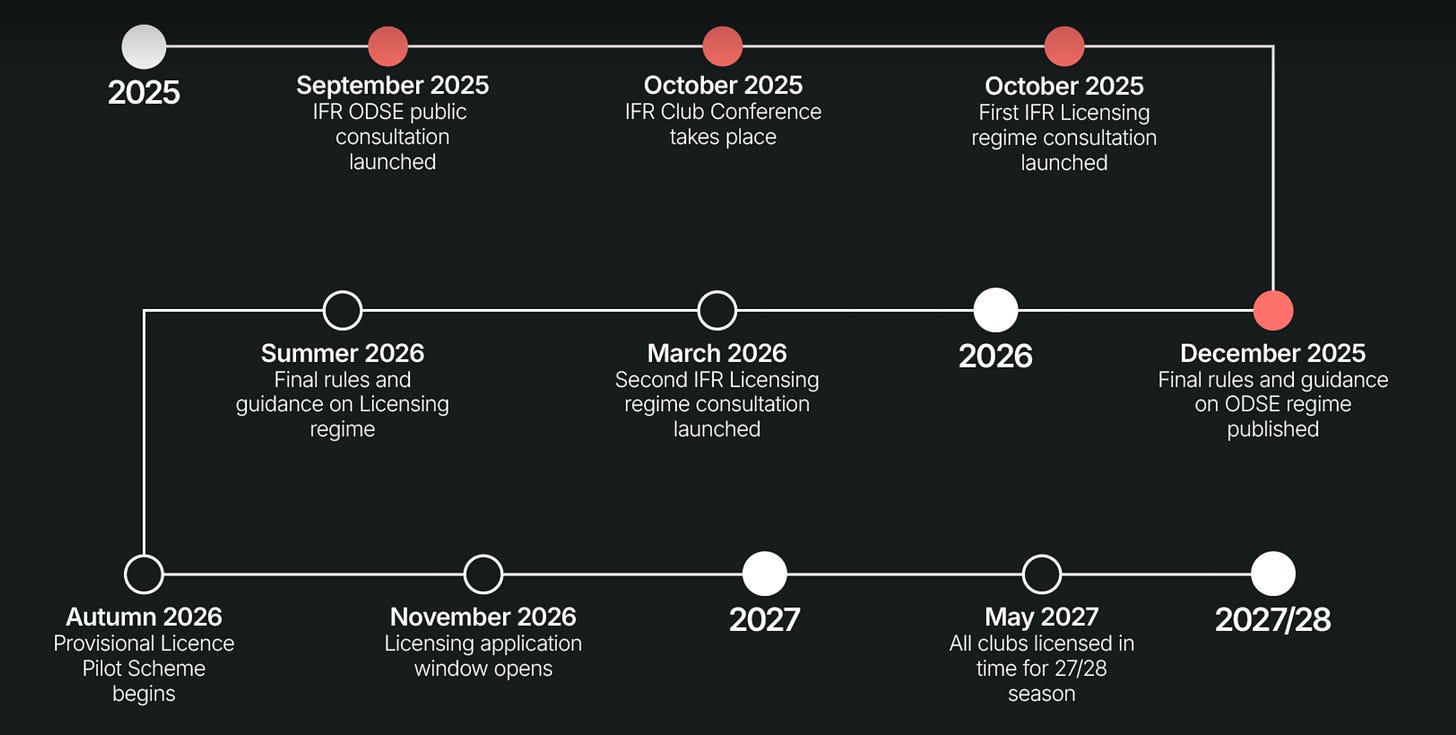
The central mechanism is licensing. From the 2027-28 season, every club must hold an operating licence to compete. During the Summer 2026 pilot phase a select group of clubs will trial the application process before the official window opens in November 2026. This timeline ensures that all 116 clubs will be operating under at least a provisional license by the start of the 2027/28 season, marking a permanent shift toward mandatory standards for financial sustainability and fan engagement.
Obtaining a licence requires demonstrating compliance with four mandatory conditions:
- Financial sustainability: clubs must show that their financial plans are realistic, stress-tested and backed by credible funding.
- Corporate governance: clubs must comply with a governance code published by the IFR and produce an annual statement evidencing that compliance.
- Fan engagement: clubs must meet minimum thresholds for meaningful supporter consultation, particularly around decisions affecting heritage assets such as the club name, crest, home colours and ground location.
- Diversity, equity and inclusion: DEI standards form part of the governance expectations the IFR applies across the pyramid. Proportionality is built in and a National League club will not face the same expectations as a Premier League operation but the principles apply to everyone.
Initial licences will be provisional and expected to run for approximately three years before converting to permanent licences once the IFR is satisfied that mandatory conditions are being met consistently. Each of the 116 clubs will be assigned a dedicated relationship officer, with the intention of maintaining ongoing dialogue rather than policing compliance from a distance. That said, the annual declaration requirement means licensing is not a one-off exercise. Clubs must confirm continued compliance with all mandatory conditions every year.
On finances, the IFR’s powers are specific. Through discretionary licence conditions, it can require clubs to meet debt management and liquidity standards, restrict overall expenditure, and block funding it reasonably suspects is connected to serious criminal conduct. What it does not do is administer the Premier League’s financial rules. The outgoing PSR regime and the Squad Cost Ratio system are the Premier League’s own rules, and the IFR sits alongside them rather than above them.
The ownership and officer regime is operational now, and since 5 May 2026 it is fully live. No one may become an owner or officer of a regulated club without first obtaining an affirmative suitability determination from the IFR, and clubs and individuals must notify the IFR as soon as there is a reasonable prospect of a change in ownership or senior personnel. Prospective owners are assessed on honesty, integrity and financial soundness, while officers face those tests plus a competence requirement. The IFR has 90 days to reach an initial determination, extendable by up to 60 days in complex cases, giving a maximum window of 150 days. Those who attempt to sidestep the process by taking up a role without a determination in place will face regulatory consequences.
The regime is not confined to newcomers. The IFR can open a review of any incumbent owner or officer where it has grounds for concern about their suitability. If it finds someone unsuitable, it can disqualify them, direct them to divest, or in the most serious cases apply for an ownership removal order — a last-resort power that can compel a forced change in club ownership through the appointment of trustees. It can also appoint its own nominee as a club officer where it considers the club’s effective operation requires it, a power with no real precedent in English football.
The revenue distribution backstop may be the most structurally consequential provision in the Act, even though it is designed never to be used. Where the Premier League and EFL cannot reach agreement on the distribution of broadcasting revenue, either can apply to the IFR to trigger a resolution process. Mediation comes first, and if that fails, the IFR can make a binding distribution order, choosing between the proposals put forward by each league. The existence of that power has already changed the negotiating dynamic between the two bodies, and neither wants to end up in front of the regulator.
Heritage protections are real and enforceable. Since 5 May 2026, clubs cannot dispose of or deal with their home ground without IFR approval, and they cannot appoint an administrator without IFR approval either. Material changes to a crest or home shirt colours require majority fan support, and name changes require Football Association approval. Clubs in insolvency proceedings now have a statutory duty to keep fans informed of developments throughout. These are conditions of the licence and live obligations, not aspirational commitments.
The competition organisers (the Premier League, EFL and National League) also acquired new obligations on 5 May. They must now notify and consult the IFR in specified circumstances, including where they suspect a club has breached a competition rule relevant to the IFR’s functions, and before imposing any penalty or sanction connected to such a breach. This reinforces the IFR’s position as the central oversight body and means the leagues can no longer handle significant governance matters in isolation.
The enforcement picture
The IFR’s Chair has said publicly that its information-gathering powers are “powers that nobody has had before,” and that is not hyperbole. The IFR can compel production of documents, commission independent expert reports on clubs, and conduct dawn raids. It can require individuals, not just clubs, to attend interviews whether or not they are personally under investigation, and the obligation to preserve documents arises the moment a person becomes aware that an investigation is likely, including through press reports or informal contact.
Penalties for non-compliance are serious. Financial penalties can reach 10% of a club’s annual revenue, criminal offences exist for intentional obstruction and falsification of information, and where breaches are persistent or aggravated the IFR can suspend or revoke a licence, which in practical terms means removal from competition. Mid-season protections exist, but they do not insulate a club from the consequences of what happened before.
The posture of this regime is what will most surprise those used to dealing with the FA and the leagues. This is proactive supervision. The IFR is not waiting for evidence of a breach before asking questions. It is building a continuous picture of every regulated club, and it expects cooperation in doing so.
One further risk deserves attention. Information given to the IFR does not stay with the IFR, because the Act creates information-sharing gateways between the regulator and other public bodies. A disclosure that surfaces a potential financial irregularity can find its way to HMRC, the FCA, or the Serious Fraud Office. Responses to information requests need to be approached with the same rigour as any regulatory investigation, with privilege reviewed, consistency with prior disclosures checked, and the downstream implications understood before anything is sent.
Where things stand
The ownership regime is fully live. The licensing application window opens in six months. Clubs that have not yet conducted a serious regulatory readiness assessment are already behind. The IFR has signalled a preference for engagement over escalation, but that preference has limits and the enforcement powers exist to be used.
Nobody wants to be the case that defines where those limits are or the extent of its appetite for a battle.
Stefan Borson is Partner and Head of Sport at McCarthy Denning. He advises clubs, owners, investors and individuals across the full range of sports law, M&A and wider regulation. He can be reached at sborson@mccarthydenning.com.
McCarthy Denning advises clubs, owners, officers, investors, and connected parties on the full range of issues the IFR creates. That includes licence applications and ongoing compliance, preparing for and responding to information requests, ownership and officer suitability applications and reviews, heritage approvals, administrator appointment applications, and disputes that arise from IFR decisions. McCarthy Denning also advise on transactions where IFR exposure needs to be understood and priced before the deal is done. If you want to understand your position under the new regime, get in touch.
DATE 12/05/2026

